Quick Desk Guide: Consolidating Client Timecode Notes Across Regional Brand Stakeholders
Consolidate regional client timecode notes into one pinned review log. Structured links cut revision loops to a median 2.4 rounds versus 4+ by email.
Reviewing v02, a regional brand manager can leave a perfectly reasonable note on a cut already addressed in v04. Without a pinned log that records the version, region and decision for each comment by the following screening, the assistant will be left rebuilding approval history from scattered email timestamps.
What are the verified benchmarks for consolidating client timecode notes across regional brand stakeholders? #
When review links carry timecode-pinned threads, revision loops settle at a median of 2.4 rounds compared with 4+ rounds for unthreaded email chains [Frame.io Workflow Study, 2025]. That figure gives post producers something solid to budget against, as long as every stakeholder views the identical published version.
Distributed teams working with cloud-streamed proxies and frame-accurate markers trim handoff waits by up to 78% compared with shipped drives [LucidLink & Frame.io Remote Post Case Studies, 2025]. The delivery matrix remains to be managed, since enterprise campaigns routinely generate 3 aspect ratios plus localised caption tracks from a single hero sequence [Wistia State of Video Report, 2025]. Because 89% of businesses now use video as a core marketing tool, that coordination warrants a permanent slot in the schedule [Wyzowl State of Video Marketing, 2026].
| Benchmark | Verified figure | Operational read | Source |
|---|---|---|---|
| Structured review revision loops | 2.4 rounds median | Versus 4+ rounds through email | [Frame.io Workflow Study, 2025] |
| Handoff wait reduction | Up to 78% | Proxy streaming and markers versus shipped drives | [LucidLink & Frame.io Remote Post Case Studies, 2025] |
| Deliverable matrix | 3 aspect ratios | 16:9 master, 9:16, and 1:1 or 4:5 plus caption tracks | [Wistia State of Video Report, 2025] |
| Billable editor utilization | 65% to 75% | Remaining 25% to 35% for ingest, renders, QC, templates | [Promethean Agency Operations Benchmark, 2025] |
Healthy boutique agencies aim for 65% to 75% billable editor utilisation [Promethean Agency Operations Benchmark, 2025]. The remaining 25% to 35% is already absorbed by ingest, render queues and template maintenance. Consolidating notes therefore requires its own allocation inside that margin, ideally locked before a Friday client screening turns every unresolved regional comment into an urgent flag.
Step-by-step Premiere Pro and DaVinci Resolve setup for consolidating client timecode notes across regional brand stakeholders #
Premiere Pro: structure before notes arrive #
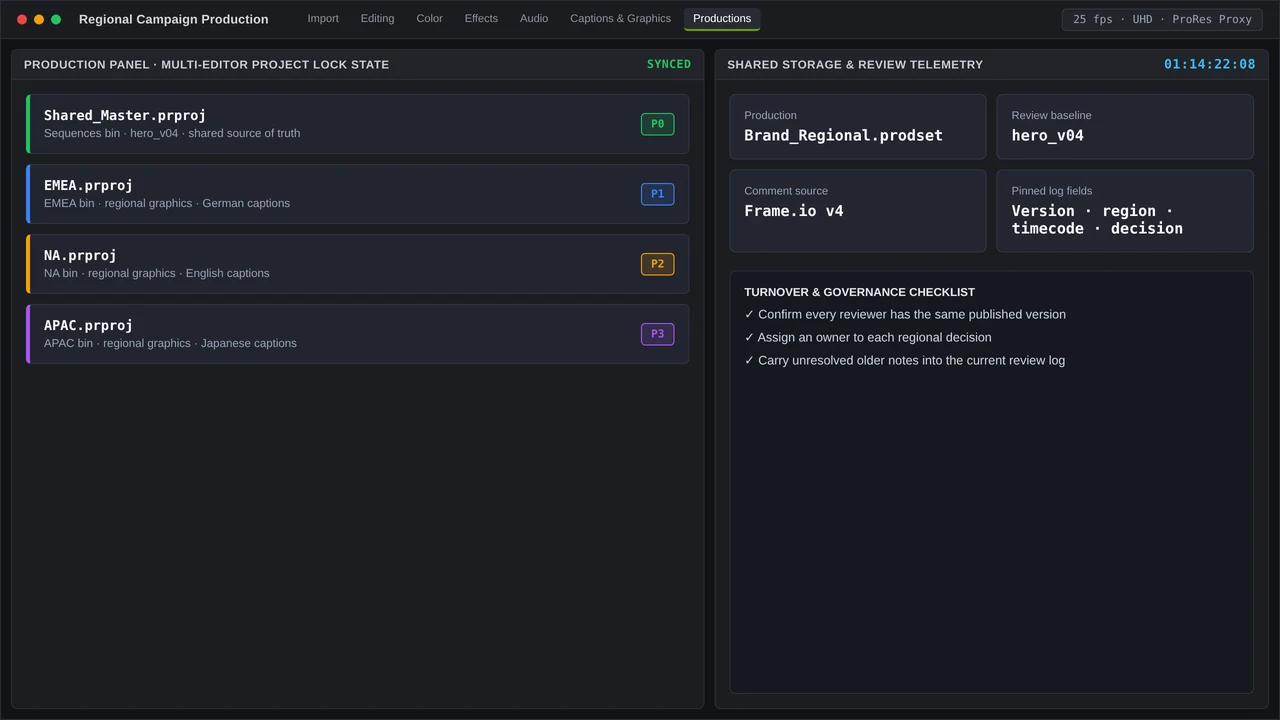
Where regional editors handle separate campaign versions, run the job as a Production (.prodset) with projects assigned with clear ownership. If a small group shares one hero edit, a Team Project remains the lighter option. Encode region, aspect ratio and version directly into bin names, for example EMEA_VERT_v03, so an assistant can route a note to the correct sequence without opening each timeline.
Link Frame.io v4 so its timecoded comments land as Premiere markers, and verify the published version before circulating the consolidated log. Handle caption wording in the Text panel and refine selected text and caption styling in Properties. Pull approved lower-thirds from the Graphics Templates panel, since local copies tend to linger well beyond the latest brand package.
After sign-off, lock the approved hero bin against further changes, and within a Production keep that hero in its own project with project locking controlling write access. Budget review seats alongside editorial, with the single-app annual plan starting at $23 a month and Frame.io Pro adding $15 per user per month.
DaVinci Resolve: reconcile notes on Studio #
Resolve Studio is available for $295 on a perpetual licence and handles colour-led review sessions well. Give each region its own marker colour, import the consolidated marker list, then confirm its timecodes align with the Premiere sequence before grading begins. A caption draft can come from Neural Engine transcription, provided a human review pass is scheduled ahead of regional approval.
Leave the Premiere sequence as the canonical source for graphics, where the broader third-party MOGRT and CEP ecosystem makes agency template handoffs faster. Inside Premiere, Excalibur ($100 one-time) covers repeated nesting and audio normalisation with deterministic macros. Transcript tools continue to carry the language work, while those macros absorb the repeatable timeline operations.
Common timeline bottlenecks and QC checks when handling consolidating client timecode notes across regional brand stakeholders #
Where the timeline chokes #
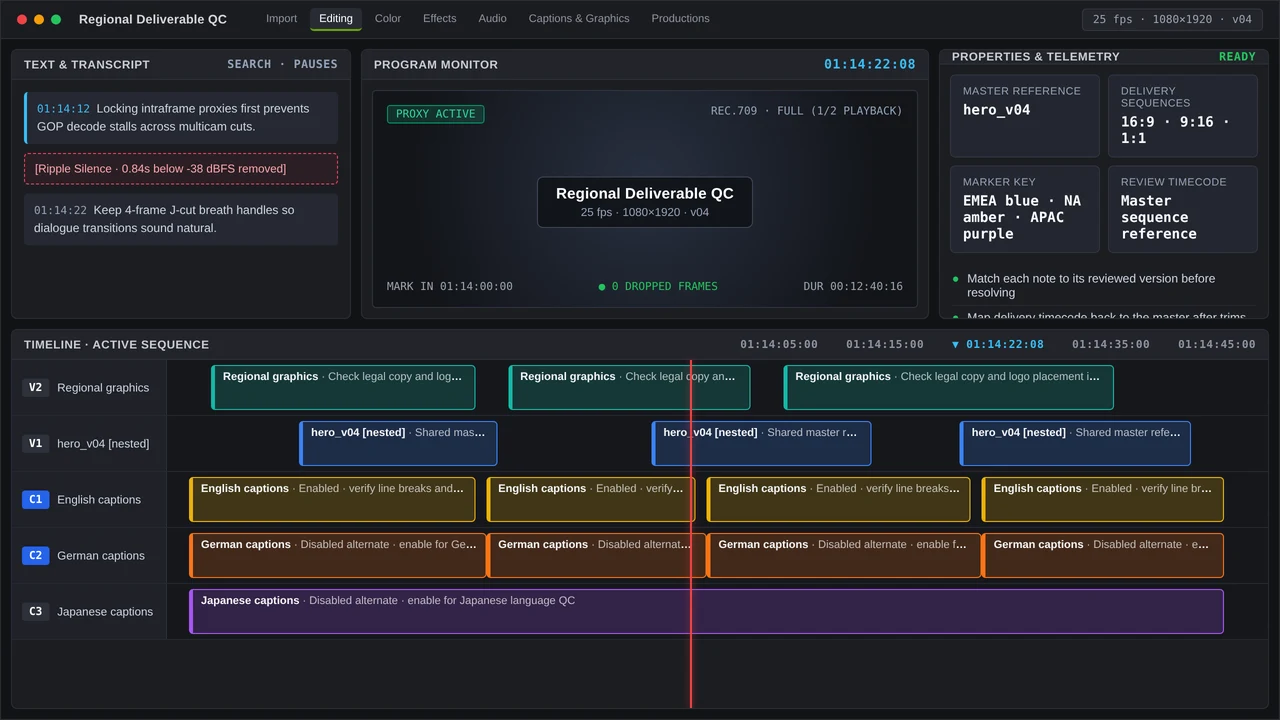
- Copies of a regional sequence tend to drift inside a week, especially after late legal amends arrive. Hold a single master and nest aspect-ratio variants from it, with reframing choices stored in those variants.
- Native speech-to-text delivers only baseline subtitles that still require a language check. Set aside dedicated time for MOGRTs or plugins when the brief specifies automated pacing or word-by-word presets.
- Downloading camera originals can saturate the line while proxy media continues to sync. Keep review sessions on proxies and reserve camera-original transfers for tasks that genuinely demand them.
- Multiple stakeholders often leave duplicate markers on an identical frame. Consolidate repeated requests under retained regional attribution, and keep conflicting instructions open until a named decision owner resolves them.
QC checks before the next round #
- Send back any note lacking a timecode, region code or status for clarification before it reaches editorial.
- Before each review round, reconcile open comments with the marker count, with duplicates already merged into a single action accounted for.
- Verify caption tracks and lower-thirds on all 3 aspect ratio deliverables, which includes reframed shots where text clearance shifts.
- Confirm dialogue loudness sits at -16 LUFS for every regional export.
- At sign-off, use the consolidated log as the single source, move any outstanding email decisions into it, and log the approved export filename alongside the resolved notes.
More in Shared Sequence

Bin locking discipline and project splitting in Premiere Pro: lock rules, Productions vs Team Projects, and handoff benchmarks for brand teams.